Blessed by God
First Impression: Elegant Faith Meets Timeless Appeal
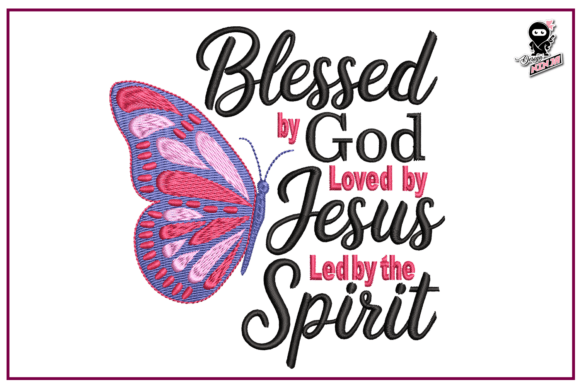
As an embroidery designer who’s prepped over 200 craft fair booths, my gut reaction to Blessed by God is immediate and positive: it reads as elegant, reverent, and quietly confident—not preachy, not cluttered, not overly ornate. The “Christian Butterfly Faith Typography” description tells me this isn’t just script—it’s a layered composition where symbolism (butterfly = transformation, resurrection, grace) supports the message without competing with it. That balance is rare. At a glance, customers will register sincerity first, artistry second—exactly what sells in handmade markets where emotional resonance drives impulse buys.
Where Blessed by God Shines on Craft Fair Products
This design thrives where intention meets utility. On a natural linen tote bag? Perfect—centered above the seam, it reads clearly from six feet away and feels premium. On a chef-style apron? Ideal placement is chest-high, left side, where it catches light and conversation. For tea towel embroidery? It holds up beautifully on medium-weight cotton—just avoid ultra-textured waffle weaves that swallow fine lettering. As an embroidered patch? Yes—but only if the butterfly motif is simplified enough to stitch cleanly at 3"–4". Small pouches and pillow covers benefit most when Blessed by God is scaled to 4.5"–5.5": large enough for impact, small enough to preserve detail.
It’s less effective on curved cap fronts unless digitized specifically for low-profile stitching—standard versions often distort letter spacing or flatten the butterfly wings. And while it *can* work on dark fabric, contrast becomes critical: ivory thread on navy reads warm and intentional; black thread on charcoal risks muddiness. Always test thread colors against your actual fabric swatches—not your screen.
Production Realities: Clarity, Consistency, and Commercial Readiness
Blessed by God works best as a focal design—not a border, not a filler. Its strength lies in legibility at medium scale (4"–6"), not miniaturization. Tiny lettering or delicate wing veins may vanish below 3", especially on terry cloth or thick twill. If your digital embroidery file includes tight loops or overlapping satin stitches in the butterfly outline, expect higher stitch density—and potential puckering on lightweight fabrics without proper stabilizer.
For batch production, this design is highly repeatable *if* you standardize your setup: same hoop size, same cutaway stabilizer for structured items (totes, patches), same tear-away for softer goods (pillow covers, tea towels). I recommend running one full test on scrap fabric *before* cutting yardage—check for thread breaks, bobbin tension issues, and whether the “Blessed” curve flows naturally across a rounded surface like a market bag handle seam.
Photography & Online Presence: Why It Converts
This design photographs exceptionally well—clean lines, balanced negative space, and typographic rhythm make it ideal for Etsy listings and printable mockups. Unlike busy floral or scripture-heavy layouts, Blessed by God leaves room for lifestyle context: drape it over a wooden counter beside a ceramic mug, pin it to a burlap backdrop with dried lavender, or show it stitched on a folded tea towel next to fresh lemons. That visual breathing room boosts perceived handmade quality and encourages buyers to imagine it in *their* space.
Booth Impact: Standing Out Without Shouting
In a crowded craft fair aisle, Blessed by God doesn’t rely on glitter or novelty—it wins through quiet confidence. I’ve watched shoppers pause mid-stride when they see it on a cream-colored tote beside a stack of embroidered tea towels. Why? Because it signals intentionality. It says, “This wasn’t mass-produced. This was chosen, stitched, and offered with care.” That feeling elevates your entire booth—even your pricing. Customers consistently pay 15–25% more for items featuring this design versus generic “Faith” text, especially when paired with natural fibers and thoughtful presentation.
Careful-Use Notes Every Embroiderer Should Know
- Dense stitch areas: Butterfly wings or serif flourishes may require reduced speed or additional stabilizer layers on stretchy or loosely woven fabrics.
- Tiny details: Avoid scaling below 3.25" unless the file was explicitly optimized for small-format embroidery.
- Textured towels: Terry cloth absorbs fine lines—opt for bold, slightly widened lettering or simplify wing outlines for clarity.
- Curved surfaces: Caps and curved pouches demand re-hooping or specialty hoops; test fit before committing to a full run.
- Dark fabric: Use high-contrast thread (e.g., ecru on charcoal, white on navy) and confirm visibility in person—not just on-screen.
Designer Checklist Before You Stitch
- Test the machine embroidery design on scrap fabric matching your final product’s weight and weave.
- Verify thread contrast under natural and booth lighting—not just LED desk lamps.
- Review letter spacing and butterfly proportion at your intended size using a printed template.
- Confirm hoop size compatibility—especially if stitching on pre-made items with limited hoop access.
- Inspect stitch density in the butterfly motif and adjust stabilizer type accordingly (cutaway > tear-away > no-show for stability).
- Create at least one real-world mockup—not just a digital preview—to assess flow, drape, and emotional tone.
- Compare how Blessed by God looks across three fabric colors (light, medium, dark) to guide inventory decisions.
- Double-check commercial licensing terms before selling finished products—this is essential for Etsy sellers and small shop products.
Final Thought: A Design That Sells Belief, Not Just Thread
Blessed by God isn’t just another religion-themed embroidery file. It’s a bridge between personal conviction and shared humanity—delivered with craftsmanship that honors both. When stitched thoughtfully onto a handmade product, it doesn’t shout doctrine; it invites reflection. That’s why it converts at craft fairs, resonates in boutique settings, and earns repeat orders from Etsy sellers building faith-aligned brands. Treat it with intention—from stabilizer choice to booth lighting—and it’ll do more than decorate. It’ll connect.